

Nory Reid
Everyone loves the look of a crystal-clear lake. Such a beautiful vibrant color, reflections like artistically poured glass, a clear lake on a bright sunny day can be one of the most beautiful places to gather for a swim, to fish, or even for a picnic with the family. But over time our lakes in the Adirondacks have become less clear. Compared to the 1980’s, most Adirondack lakes have changed from clear and blue to a murky brown. Sounds ugly, right? I wanted this project to reflect on our changing lake transparency and invite viewers to see a different kind of beauty in this trend- and learn about the effects the loss of our “crystal-clear” lakes will have on our ecosystem.
The Science
The transparency of our lakes can mostly be attributed to the increased amount of decaying organic matter in our water. In the 1970’s, scientists were met with highly acidic and hauntingly clear lakes that were devoid of life. This phenomenon, dubbed “acid rain” began to change after amending the Clean Air Act in the 1990’s. Biodiversity began to return, but after nearly a century of acidic rain it was difficult for our soil to absorb and hold onto organic acids from decaying plants. With nowhere else for it to go, this organic matter eventually is carried away and dissolved into our watersheds. It’s like a tea bag- when you put a bag of tea in water, the compounds in the tea leaves begin breaking down and dissolve into the water. That’s how tea gets its color and flavor.
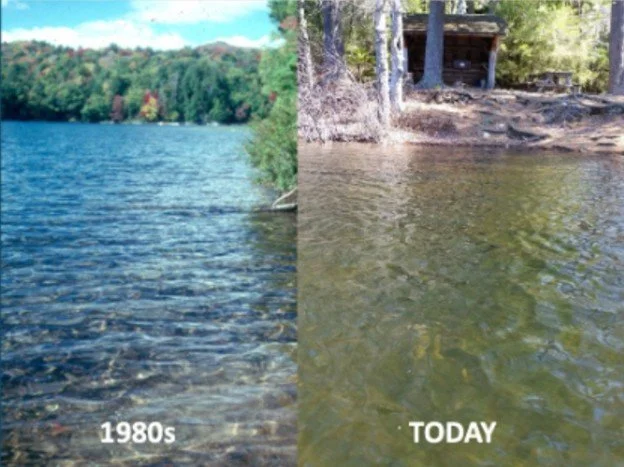
While the acidity of our rainwater has since decreased with the number of regulations on industrial air pollution, the effect it has had on our soil has still not decreased, meaning our lakes are getting darker and cloudier. This change has had a significant effect on our lake and wildlife health. Over time our lakes have gotten warmer, and less oxygen is dissolving into the water. This has become a significant problem for fish such as brook trout and Atlantic salmon, which struggle to find a balanced zone in the lakes they inhabit where the water has enough oxygen without being too close to the warm surface. While extremely deep lakes (over 30 meters deep) do not have as much of a problem with this phenomenon, only about 1% of lakes in the Adirondacks meet those requirements. The optimal habitat for these fish is shrinking.
While too much lake browning is detrimental to aquatic health, so are lakes that are too clear. Dissolved organic matter creates a buffer for the deeper zones of the lake, keeping the temperature of these lakes regulated. Making sure that our lakes have a deep enough zone of cold water and oxygen-rich environments is incredibly important to the health of our fish species. Clear water is also considered an indicator of invasive species such as zebra mussels. These mussels, which have caused immense damage to water systems outside the Adirondacks, filter out the organic matter that causes lake browning in the first place. A lake that’s too clear may mean that these bivalves have invaded the water system and filtered out all organic nutrients that are important to the ecosystem.
Sources
1. Most Adirondack lakes will likely become unsuitable for trout | Cornell Chronicle
2. Lakes in the Adirondacks are getting browner. Here’s why that’s bad. - newyorkupstate.com
3. Lakes recovering from acid rain - Adirondack Explorer
4. Smeltzer, E., et al., Environmental change in Lake Champlain revealed by long-term monitoring, J Great Lakes Res (2012), doi:10.1016/j.jglr.2012.01.002