Rowan Perry
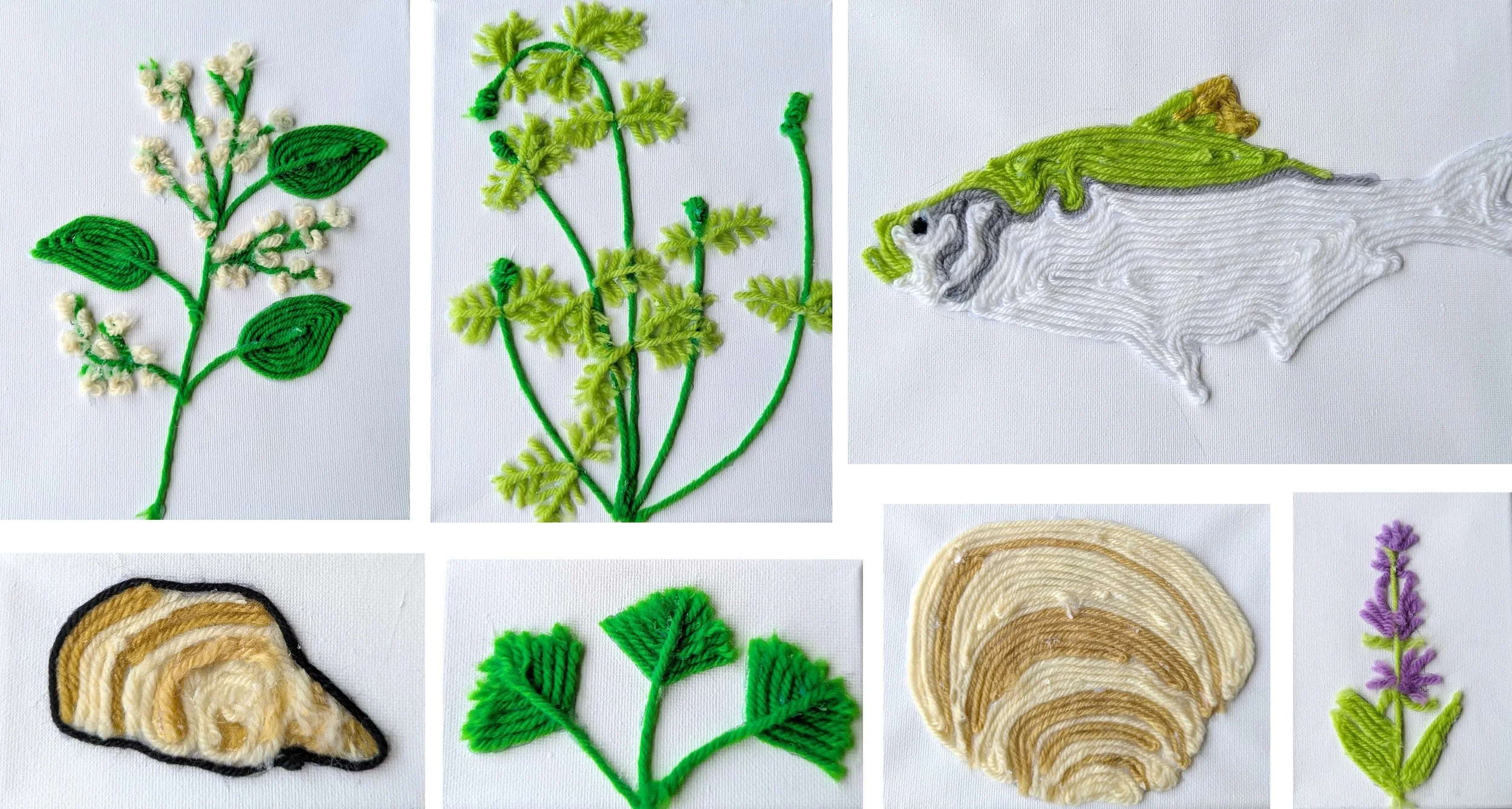
The issues I am addressing through my artwork are the seven main and high-priority Aquatic Invasive Species (AIS), which include Alewife, Eurasian watermilfoil, purple loosestrife, water chestnut, zebra mussel, golden clam, and Japanese knotweed, in and around Lake Champlain. AIS in Lake Champlain have been negatively impacting native species like salmon, trout, and mussels. The AIS have caused the food web to change, a thiamine deficiency in some predators, and cover important spawning habitat.
The goal of my artwork is to display how much of an impact each AIS has in and around Lake Champlain, according to the most recent data. I needed to figure out what way to best display the data through art, so I decided to use different sized canvas’ to represent how severe each invasive species impact currently is in and around the lake. I used information from the Lake Champlain Basin Program. Alewife has the largest effect on native ecosystems and habitats in the lake, so it is on the largest canvas.
That all being said, I choose a unique medium. I wanted to use yarn because I grew up on a sheep farm, so I decided to do yarn mosaics. I had seven different sized canvas, typically used for painting as my base or background. I wanted to work on a raised surface; something flat did not really feel like it had as much meaning to me. I also wanted my artwork to reach audiences of all age ranges and backgrounds. I wanted to make sure that they could understand how certain invasive species can have an impact on one lake. To start, I picked out what each canvas would have on it and then did a sketch of the outline in pencil as shown in the picture to the left, my basic sketch of an alewife fish. Then I filled in what colors would go where and also picked what colors of yarn I would use for each species. I had to try a few different types of glue because one would stick to the canvas but not the yarn, and another one had the opposite effect. I ended up using hot glue which worked great. The only challenge of using hot glue was a few slight burns and the strings of glue everywhere. It worked great otherwise! The yarn held is shape perfectly and I could mold it in any direction I needed it to go.
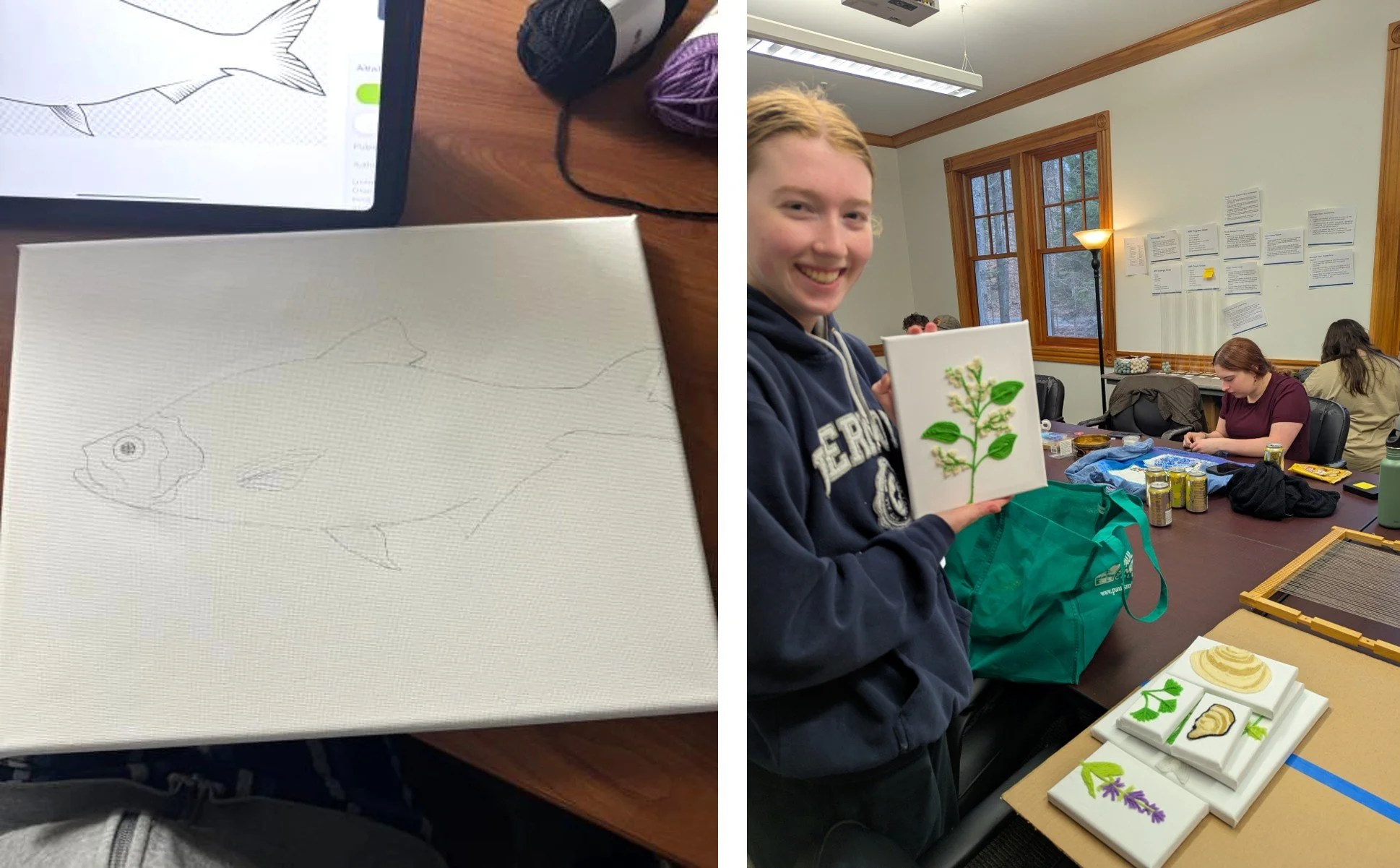
The most time-consuming part was the little white flower buds on the Japanese knotweed and the leaves on the Eurasian watermilfoil; those took me about 3 hours in total to do. It was a very tedious process, so I am thinking of ways I could have done those parts differently. Everything else took about 2 hours to do and was a lot easier because I could use bigger and longer pieces of yarn instead of tiny individual pieces that took a bit to cut, glue, and cool off. Overall, despite the burns and tedious work of cutting yarn, I am extremely happy with how my artwork turned out!
Some things I hope that my audience will take away from my project are how damaging these species can be, what can happen due to human negligence, and what we can do to help mitigate and protect native species in Lake Champlain. My audience should pay more attention when taking their boats to and from Lake Champlain! They should also be more educated on what an Aquatic Invasive Species is, what AIS stands for, and how we can become stewards of this essential freshwater resource.
Sources
· https://www.lcbp.org/our-goals/healthy-ecosystems/aquatic-invasive-species/ais-in-the-lake/
· https://dec.vermont.gov/watershed/lakes-ponds/aquatic-invasives/aquatic-invasive-species-map
· https://www.adkwatershed.org/all-publications/pathways-of-invasion