
Wake Sports and Wake Boats
What are Wake Sports and Wake Boats?
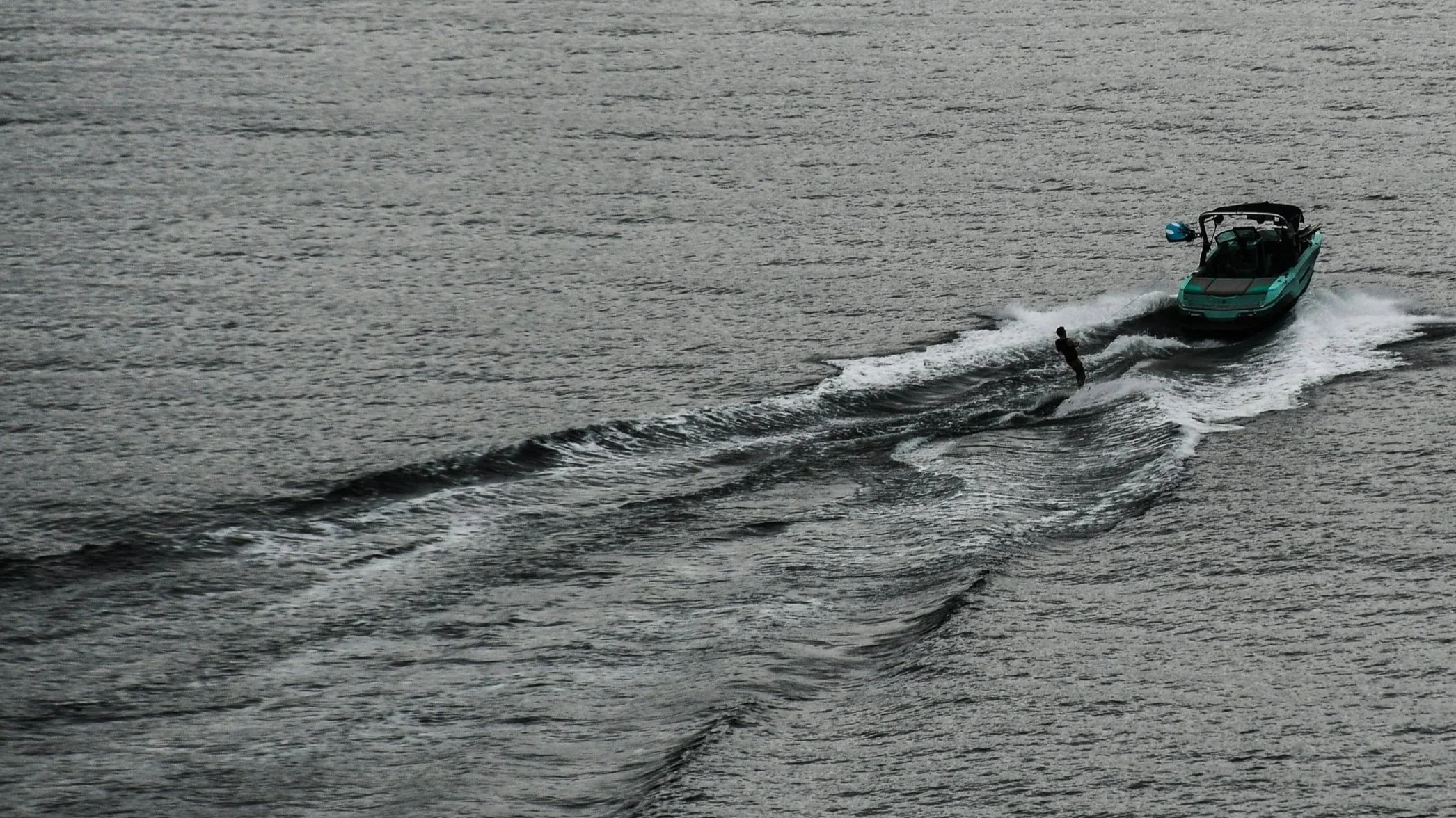
Wake sports—including wakeboarding, wake surfing, wake skating, and water skiing—use the wave created by a moving boat for recreation. While any motorboat creates a wake, specialized wake boats are designed with unique hulls and ballast tanks that displace more water, producing larger, more powerful waves. Wake sports have grown rapidly over the past 10–15 years, and wake boats are becoming increasingly popular across the country, including in the Adirondacks. As their use expands, understanding their environmental impacts and practicing responsible and sustainable operation is increasingly important.
How Can Impacts Be Reduced?
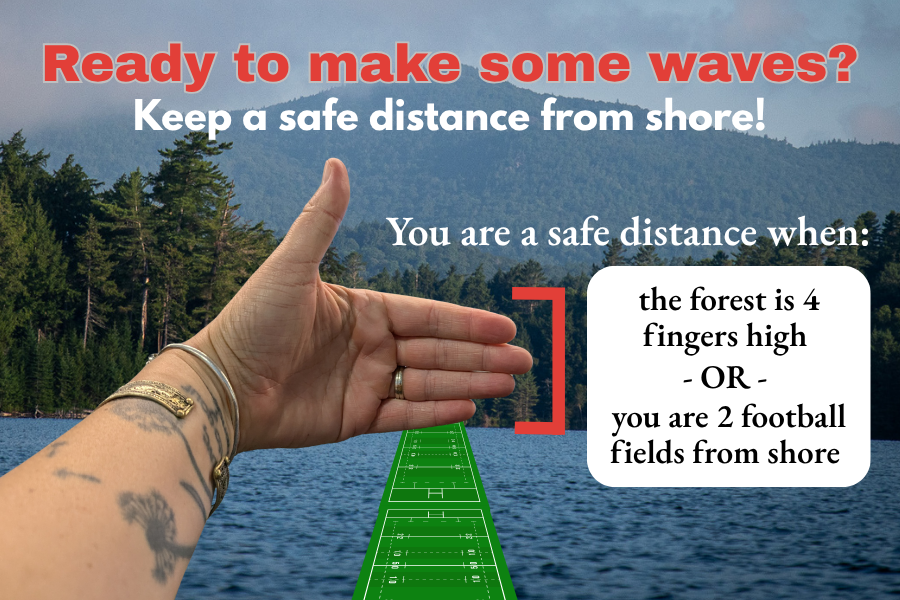
Although every lake is different and it’s best to learn more about lake conditions before you go, there are some simple guidelines that will minimize damage to the lake ecosystem. Operate wake boats in wake-enhancing mode only when you are:
At least 500 feet from shore
In 30 feet or more of water
At least 200 feet from other boaters
Avoiding repeated passes of the same area
Always Clean, Drain, Dry your boat and equipment before moving to and from a waterbody.
Cover photo: Photo by Dynamic Hong Kong on Unsplash
How Can Wake Boats Impact Lakes?
When operated responsibly, wake boats can have minimal environmental impact. However, using wake-enhancing modes in shallow water or close to shore can increase the risk of:
Shoreline erosion
Resuspension of bottom sediments and nutrients
Damage to aquatic habitats, including loon nesting sites, fish spawning beds, and vegetation
Damage to docks and other shoreline infrastructure
Swamping of small watercrafts, such as kayaks and canoes
Wake boats also present challenges for preventing the spread of aquatic invasive species (AIS). Their ballast tanks can retain residual water and be difficult to access, making complete decontamination difficult and increasing the importance of following Clean, Drain, Dry practices.
Are Wake Boats Currently Regulated?
Some states, including Vermont, have state-wide regulations. Currently, NYS and the Adirondack Park have no universal regulations governing where or when wake boats may operate, underscoring the importance of education and individual ownership of safe wake sport practices to preserve the water resources we all love and share.
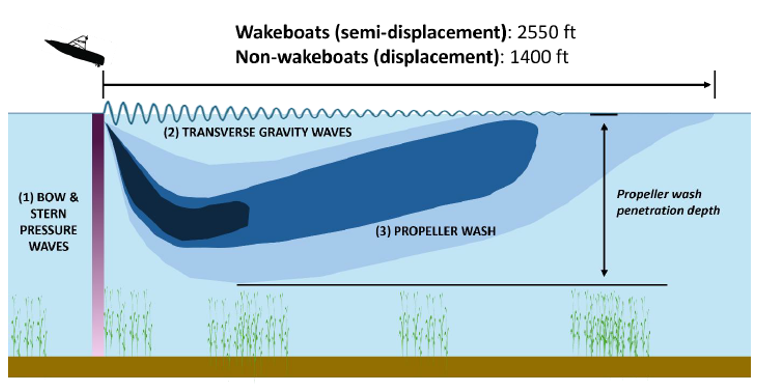
Diagram of the three hydrodynamic effects of power boats: 1) bow and stern pressure waves; 2) transverse gravity waves; and 3) propeller wash from a 2025 report and research experiment conducted by St. Anthony Falls Laboratory at the University of Minnesota (Credit: St. Anthony Falls Laboratory, University of Minnesota).
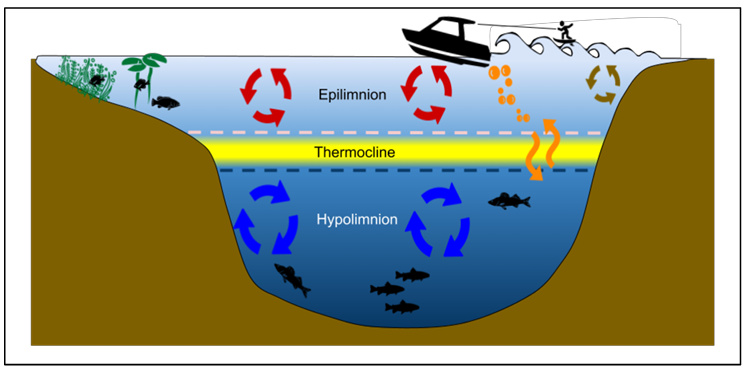
Cross-sectional view of a recreational wake boat operating in wake surfing mode and the potential impacts of wake generated waves and turbulence on disrupting the thermocline, allowing for mixing of stratified water and nutrient layers and eroding/resuspending bed and nearshore sediments (Credit: Ortiz et al. 2024, Wisconsin’s Green Fire).
Adirondack Wake Boat Coalition
The Adirondack-based Wake Boat Coalition works to promote responsible boating through education, outreach, and support for voluntary local policies. The Adirondack Watershed Institute joined this coalition to ensure that we continue to minimize negative impacts on shorelines, habitats, wildlife, and lakes while protecting healthy watersheds and promoting sustainable recreational activities. Other coalition partners include the Adirondack Center for Loon Conservation, Adirondack Lakes Alliance, Adirondack Council, Protect the Adirondacks!, and Upper Saranac Foundation.
Know the Lake. Know the Conditions. Be Wake Smart.
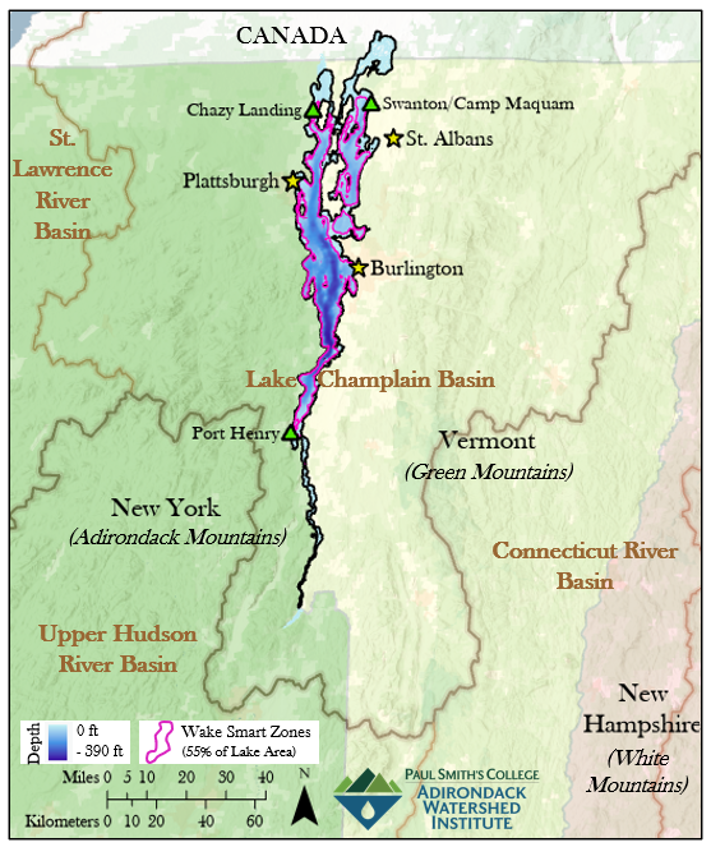
Wake Smart is an initiative to help boaters—especially those operating wake boats for wakesurfing and wakeboarding—understand where and how to enjoy these activities while protecting lake ecosystems. Wake sports require specific conditions to minimize impacts to shorelines, aquatic habitats, and water quality. The ideal location varies from lake to lake because depth, size, shoreline characteristics, and other conditions are different in every waterbody. Below are examples of areas on Upper Saranac Lake and Lake Champlain where conditions are suitable for wake sport activity. These areas illustrate what a Wake Smart Zone can look like, but each lake requires its own approach based on its unique characteristics.
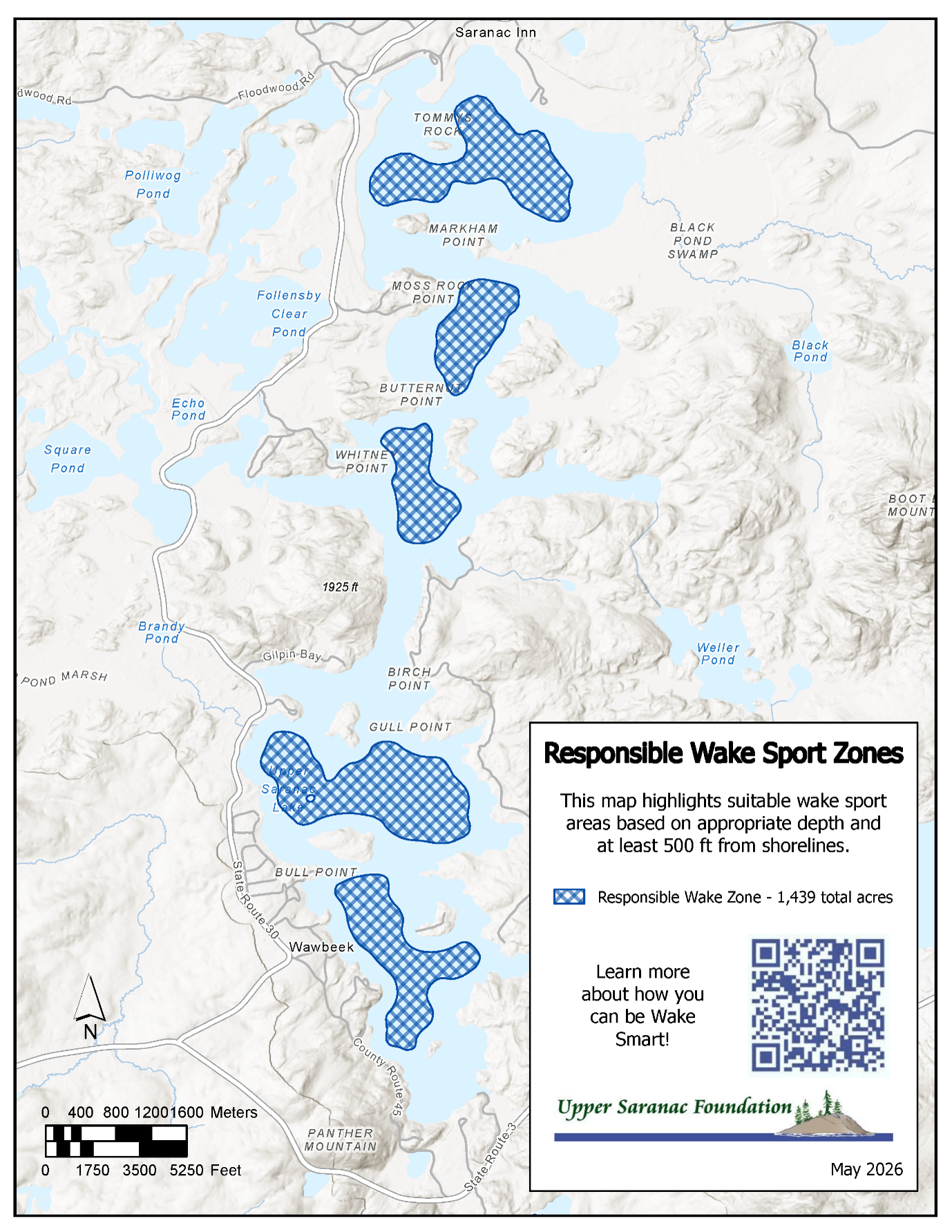
Responsible wake sport zones (1,439 discontinuous acres) on Upper Saranac Lake, identified in areas at least 500 feet from the shoreline and in water greater than 30 feet deep (Credit: Upper Saranac Foundation).
“Wake Smart Zones” (pink) or areas of responsible wake sport activity on Lake Champlain (153,037 discontinuous acres or ~55% of Lake Champlain’s area) including much of Mallets Bay, the Northeast Arm, and the Main Lake from roughly Chazy Landing, NY/Camp Maquam, VT at the northern most extent to Port Henry, NY at the southernmost extent. Areas identified as at least 500 feet from the shoreline and in water greater than 30 feet deep (Credit: Adirondack Watershed Institute).
Wake Boat Research in the Adirondacks
Researchers are studying how wake boats affect Adirondack lakes to better inform management and education. The Adirondack Watershed Institute is currently looking for partners and funding to carry on this critical research as wake sports and wake boats become more prevalent in the Adirondacks.
2023: The Adirondack Watershed Institute monitored waves and wind on Lake Placid and found that while average daily wind speed explained median wave conditions, it did not account for the largest waves. Because wave energy increases 3-9 times faster than wave height, larger waves produced by wind gusts or wake boats may contribute disproportionately to shoreline erosion and sediment disturbance than average wind conditions or non-wake boats. Large waves, especially those produced by wake boats, should be explored further.
2025–2026: The Adirondack Center for Loon Conservation is investigating relationships among boat type, wave size, distance from shore, and water clarity. The study is motivated by concerns that large wakes could wipe away loon nests and reduce water clarity, affecting loons' ability to forage.
VIDEO: University of Minnesota study on Lake Minnetonka in Minnesota on the impacts of wake boats in wake enhancing mode on lake sediments, nutrients, and aquatic vegetation at 9 ft and 14 ft water depth. (Credit: Fox 9 Minneapolis-St. Paul)
VIDEO: A resident McCullough Lake in Wisconsin responsible for the banning of wake boats in 60+ Wisconsin lakes and Master Craft wake boat dealer and enthusiasts viewpoints on the impacts of wake boats. (Credit: PBS Wisconsin)
Additional Research
Macfarlane, Gregor J. (2025), Wakesurfing, Wakeboarding, and Waterskiing: A Comparison of Wake Characteristics. River Res Applic, 41: 1189-1206. https://doi.org/10.1002/rra.4438
Marr, Jeffrey; Riesgraf, Andrew; Herb, William; Lueker, Matthew; Kozarek, Jessica; Hill, Kimberly. (2022). A Field Study of Maximum Wave Height, Total Wave Energy, and Maximum Wave Power Produced by Four Recreational Boats on a Freshwater Lake. Retrieved from the University Digital Conservancy, https://hdl.handle.net/11299/226190.
Ortiz, David A; Meyer, Michael; Daulton, Terry; Kovar, Bob. (2024). The Effects of Wake Boats on Lake Ecosystem Health: A Literature Review (May 2024 Update). Pralle, Carolyn; Behm, Don (Ed.). Wisconsin’s Green Fire: Voices for Conservation. https://wigreenfire.org/wake-boats-lakes-update-may-2024/
Riesgraf, Andrew; Marr, Jeffrey; Herb, William; Lueker, Matthew; Kozarek, Jessica. (2025). A Field Study of Recreational Powerboat Hydrodynamics and their Impacts on the Water Column and Lakebed. Retrieved from the University Digital Conservancy, https://hdl.handle.net/11299/274184.