
Isaac Kristich
This project is a mixed medium display utilizing photographs and string art. As the title suggests, this project was designed to show the interactions that humans have with waterways, specifically the Saranac River in the Adirondack State Park. The goal of this project is to bring awareness to the impacts we have on waterways through obstructions like dams and bridges. While I did not want to focus entirely on the negative impacts that we have and did include some photographs of unobstructed waterways, I also did not want to undermine the main message, which is that humans have altered the flow of waterways, which has a far bigger impact than just what we see at the dams themselves. Besides just demonstrating the impact that we have on waterways, this project has a secondary purpose: to show how humans create infrastructure differently than nature and in a way that does not always keep Mother Earth's best interest in mind.
The Science
Dams change rivers fundamentally in 3 different ways. They disrupt the natural flow patterns, increase turbidity and sediments in the water, and alter the temperature of the water. The first disruption is fairly obvious and visual. When you look at a dam, you can see that the water is not flowing in a natural way. The water is pooled up behind it and comes crashing over the edge of an artificial waterfall that naturally would have just been a continuation of the river. The second disruption is linked to the waterfall that is created. When water comes crashing over the barrier, it picks up sediment from the bottom of the waterway that otherwise would have been left there. This increased sedimentation makes the lakes less habitable for animals like fish, as well as certain aquatic plants that have a lower tolerance to disturbances. The temperature change is related to the pooling of water behind the dam. When water sits still, like in a pond, it is able to warm up from the sun and ambient temperature. When it is flowing, it is much harder for its temperature to rise as significantly. This pooling can also have the opposite effect if it becomes deep enough, the bottom layers of water are more insulated than they would be normally and become colder than what the river would have been pre-dam. Many species, like Brook and Lake Trout, are very sensitive to temperature change, and if the input of the dam in the first place did not make them leave the river, the temperature changes could. More information here on specific harms that dams can cause. Many people believe that just putting a fish ladder on the side of the dams will mitigate every issue, but in reality, it is much more complicated than that. Not even removing the dams is a perfect solution because the impact that it has can permanently alter the watershed as well.
The Artwork
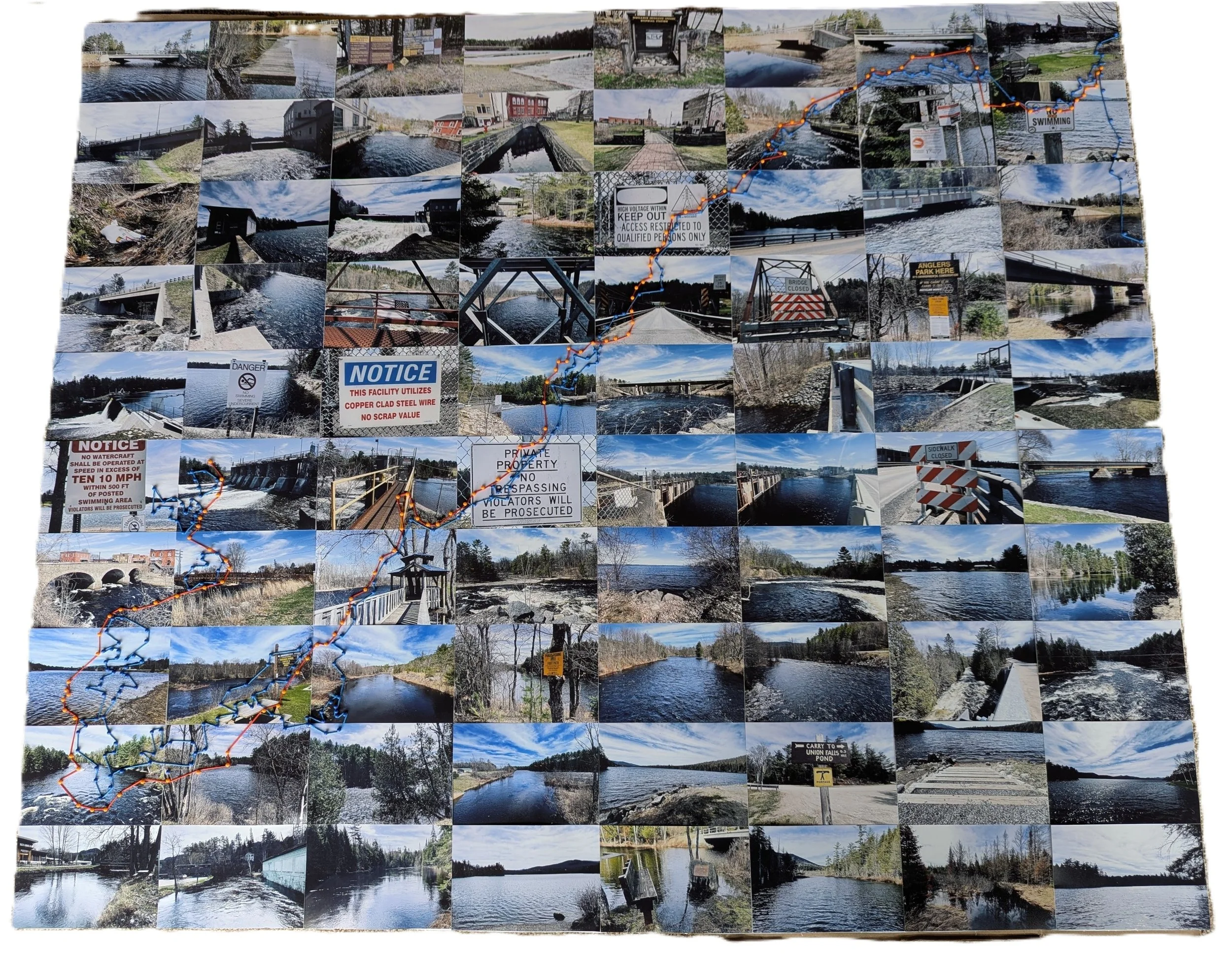
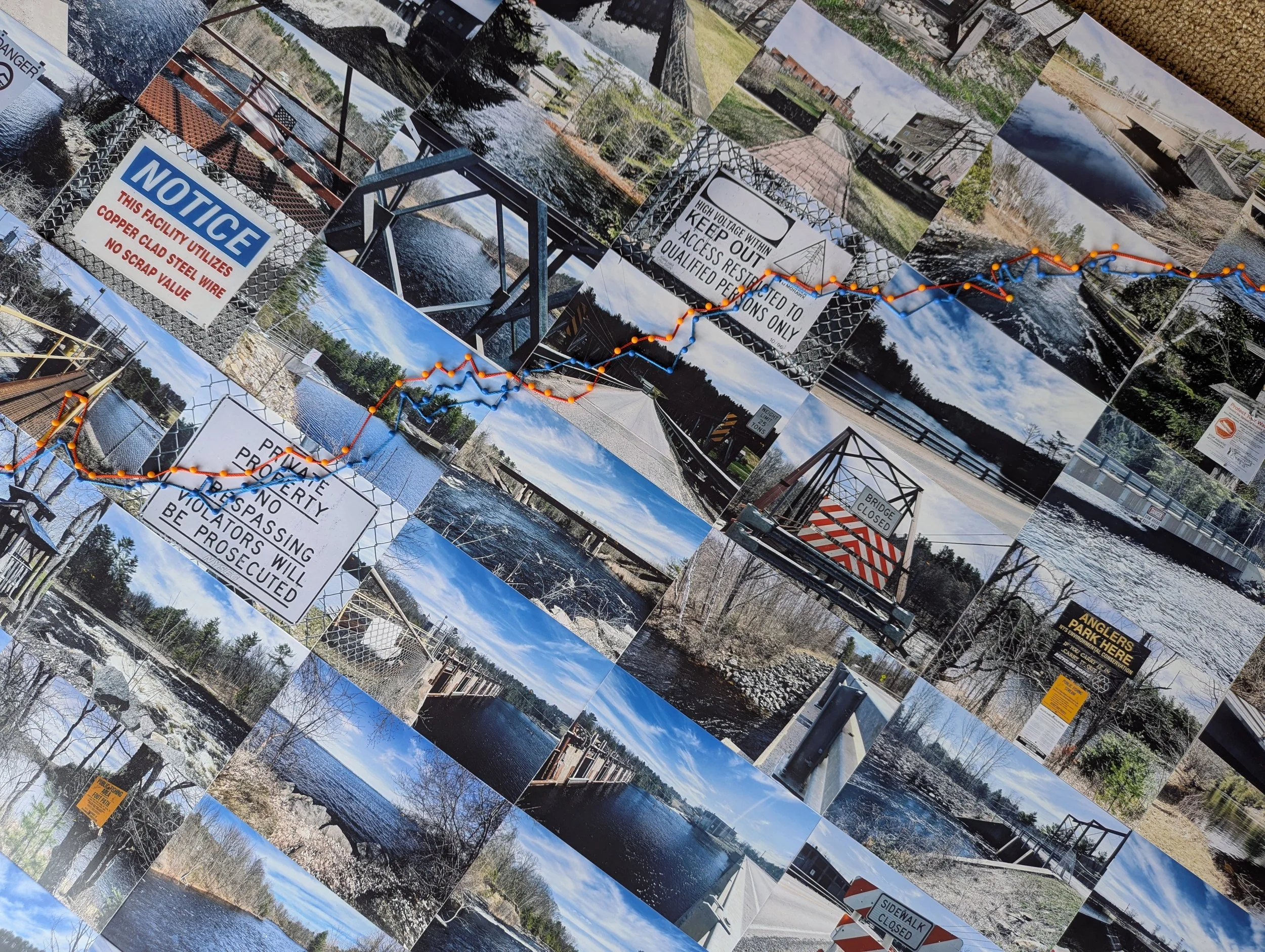
The main art piece is the collage of photos, each one is demonstrating something from along the Saranac River. Many of them are photos of the numerous dams along the way. Others are of bridges which seem much less harmful than dams, but can cause equal problems depending on construction. The rest either show smaller disturbances like boat launches, signs of use like invasive species collection points, or the river in an undisturbed state, because not everything is negative. The secondary element of the piece is to show the differences between human and natural infrastructure. The blue lines pinned on the map represent the river and lakes, and the orange line is the route that I took following the river. Despite creating a route that followed the river as close as I could, you can clearly see that roads often do not line up with the river, even though that is what nature dictated was the most efficient route. Another thing to notice regarding the human infrastructure is the number of signs telling you “No.” Eight of the 80 photographs are something along the lines of “No trespassing” or “No swimming.” While both of those are very good pieces of advice in many of these areas, that is still a problem created by the dams. Without them, there would be no need to warn against that because it would be totally safe. Because much of my art project relies on GPS data, I created an interactive map showing the route I followed and the pictures taken at each spot, which can be found here.
The Bike Ride
As part of this project, I decided to ride my bike along the 97-mile route and take all the photos used in this piece during that ride. I believe that my main reason for doing this was to set a goal of something I had never done before and to do it, but there is an artistic choice behind that as well. This piece is supposed to reflect the interactions and connections we have with nature, and biking fits right into that interconnected spot. If I had driven a car the whole way, I would have been 100% powered by human infrastructure, not a very ideal mode of transport when creating a project showing the negative sides of that infrastructure. On the other hand, a 100% natural way of doing this route would have been to walk or run. Besides the obvious fact that running 100 miles would take far too long, if even possible for me to do it also does not really demonstrate the connectedness between infrastructure and nature. A bike does, however, because it is still a machine built by humans, but it is entirely powered by nature and allows you to be entirely in the outdoors.
Conclusion
While I did not create this project in the hopes that one would read this and start advocating to tear down dams near them, I did want to bring awareness to the impacts they and other human obstructions can cause. One of the photos I included in the final display was an empty case of beer lying in a ditch, acting as a sort of mini dam holding back the snow melt. I felt like this was the exact type of thing I am hoping to avoid with this project. While it may be beyond your power to eliminate dams and bridges blocking major waterways, everyone has the time to pick up trash and make the environment near you cleaner and free of the infrastructure we have imposed upon it.