
Wake Boats in the Adirondacks: A Look Back at Our Summer Inspections
By Sara Kelly, Research Scientist at the Adirondack Watershed Institute
Adirondack waters are a mecca for conservationists, artists, wildlife viewers, and recreationists among residents and visitors alike. Recreational boating, whether for leisure, angling, or watersports, is a popular activity and motorboats represent the most abundant vessel type on Adirondack lakes.
Motorboats are often specialized for specific activities such as pontoon boats for leisure, low-profile fiberglass boats for tournament bass fishing, jet boats for water sports such as water skiing and tubing, and more recently, wake boats or ballast boats for wake sports such as wake surfing. Wake boats have become increasingly popular over the last decade, as their large ballast tanks and specialized hulls displace more water than a traditional motorboat, creating a large wake that is able to be surfed without a rope.
Because they displace more water and create larger waves than most motorboats, there is concern that wake boats may impact lake bottoms, shorelines, non-motorized boaters, and infrastructure more than typical motorboats. Accordingly, emerging guidance suggests that wake boats, when operating in displacement mode or with additional trim tabs to create larger wakes, should stay at least 500 ft from shore, operate in 30 ft of water or more, maintain at least 200 ft from other boaters, and avoid repeated passes in the same area.

“All the Water” by Ryan Sajdak (2026) showing the 11,212 lakes and ponds, 13,459 miles of rivers and streams, and 359,033 total acres of water within the Adirondack blue line.
Understanding the Impact of Wake Boats on Adirondack Waters
In the absence of formal regulations for wake boats in New York State or the Adirondack Park, the Adirondack Watershed Institute (AWI) wanted to understand: 1) where wake boats are launching in Adirondack lakes and ponds, 2) what proportion of all launching boats are wake boats, and 3) when wake boat use is the highest between Memorial Day and Labor Day weekends.
Using Pilot Data to Address Our Questions
Boat inspection and decontamination data were acquired from the AWI Aquatic Invasive Species Spread Prevention Program during peak boating season, from May 22nd to September 7th of this year (Memorial Day to Labor Day weekends). This program, which has been in operation for over two decades in partnership with the NYS Department of Environmental Conservation, inspects roughly 80,000 boats in any given season.
While the goal of the program is to stop the spread of aquatic invasive species from entering relatively pristine Adirondack waters through inspection, decontamination, and education of Clean, Drain, Dry practices, the data collected can also be used to answer questions about wake boat presence. While information collected and used here pertains only to lakes and ponds where stewards are present and reflect a pilot year of wake boat data collection, these data, in combination with field anecdotes, provide a snapshot of where and when wake boats are present in Adirondack waters.
A Snapshot of Wake Boat Use
Between Memorial Day weekend and Labor Day weekend of 2026, AWI inspected wake boats at over half of our inspection stations and in nearly two-thirds of the lakes and ponds where we have stations. Of our 68 total stations throughout the park, we inspected the highest number of wake boats at Brant Lake, Fourth Lake, Great Sacandaga Lake, Indian Lake (Hamilton County), Lake Champlain, Lake Placid, Schroon Lake, and Upper Saranac Lake.
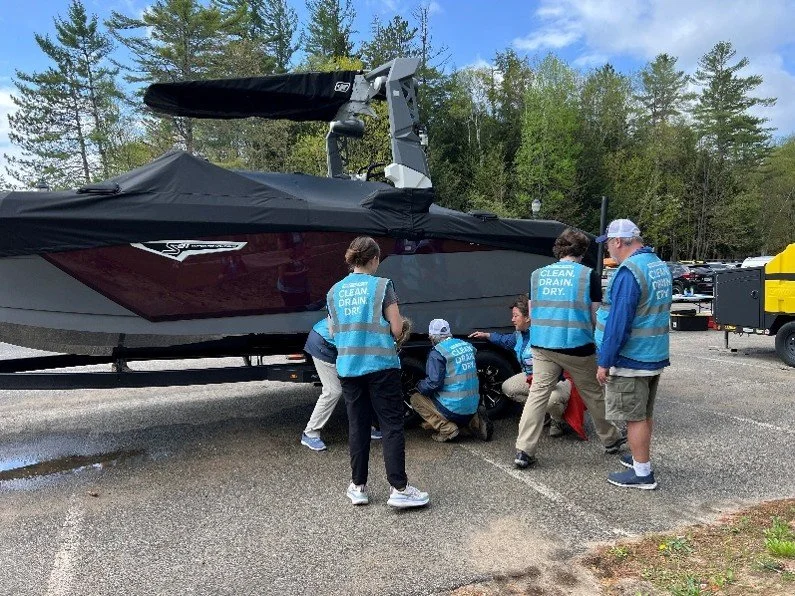
AWI watercraft inspection stewards learn how to identify, inspect, and decontaminate a wake boat at the program’s annual spring training.
Reported wake boats made up only about 0.2% of the roughly 82,000 boats inspected in 2026, though it is likely this estimate is underreported by an order of magnitude. Of the boats inspected, 5% of wake boats received decontamination, which is on par with the rate of decontamination for all boats. Even if wake boats were significantly underreported in this pilot year, these data still suggest that wake boats represent a small percentage of all boats recreating on Adirondack waters.
The greatest number of weekend wake boat inspections took place July 3-5, followed by August 7-9, and June 26-28. Between June 22nd and August 9th, AWI inspected nearly two-thirds of all wake boats for the season. During this same period, AWI inspected a little more than half of all boats for the season, suggesting that the wake boat season is concentrated to peak summer.
What More Do We Know About Wake Boats Using Our Data?
Where are wake boats? While wake boats are found on a variety of lakes and ponds, they appear to be most popular on large, deep lakes such as Brant Lake (65 ft), Fourth Lake (85 ft), Great Sacandaga Lake (74 ft), Indian Lake (85 ft), Lake Champlain (391 ft), Lake Placid (151 ft), Schroon Lake (152 ft), and Upper Saranac Lake (93 ft). Upper Saranac Lake and Schroon Lake have mapped out responsible wake sport zones based on depth and distance to shore guidance mentioned earlier in this article. These “wake-smart” maps can be found on the AWI, Upper Saranac Foundation, and Schroon Lake Association websites.
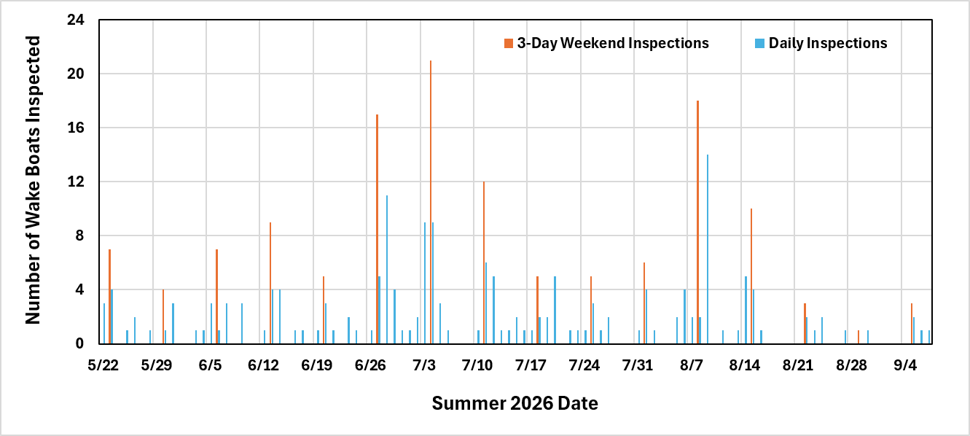
Number of daily wake boat inspections (blue) and three-day weekend (Fri-Sun) total inspections (orange) across all inspection stations.
How many wake boats are there? Wake boats still seem to represent a small fraction of total boats in the Adirondacks. This may be the result of several factors. Wake boats are highly specialized boats that do not have widespread popularity outside of the wake sport community. They are also more expensive than other entry-level boats used for fishing or recreation and are difficult to transport due to their size. We are also likely to underestimate the total number of wake boats because we cannot account for wake boats at private docks and boathouses that may have entered the lake prior to Memorial Day weekend this year. Wake boats may also be undercounted because they are difficult to discern from other motorboats and are highly variable.
When are people using wake boats? The weekends surrounding the Fourth of July showed the busiest wake boat activity. These were also the busiest weekends in the Adirondacks for boating recreation in general. As expected, wake boat popularity peaks between late June and early August, when air and water temperatures are most conducive to water sports.
In summary, the Adirondacks are a major destination for watercraft and watersport recreation, as evidenced by the more than 82,000 boat inspections taking place between Memorial Day and Labor Day weekends. While wake boats make up a small percentage of total boats at inspection stations, wake boats still have a presence in Adirondacks waters, with well over half of the most accessible, high use lakes and ponds reporting their presence. While large, deep lakes seem to be most popular, wake boats were reported at small, shallow lakes such as Lake Flower, where they may have greater environmental ramifications. AWI will continue to train boat inspection and decontamination stewards on wake boat recognition so these data may be of greater use in years to come, potentially helping to track the growth of wake sport popularity in Adirondack waters.