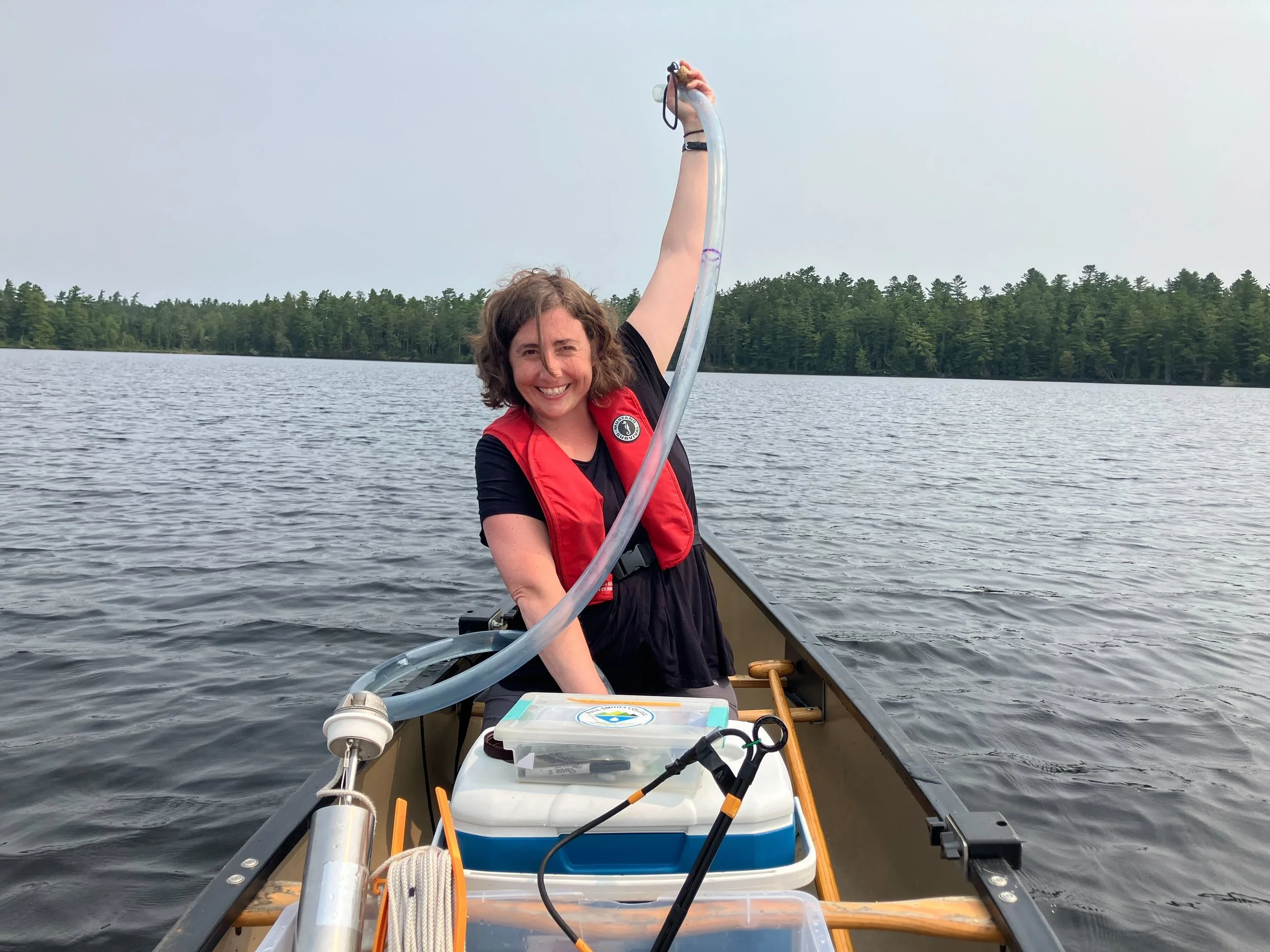
AWI’s Research Scientist, Sara Kelly, conducting water quality monitoring on Lower St. Regis Lake. (Photo Credit: 2025, Bobby Clark.)
Ever wonder how healthy that lake you swim or boat in all summer is? The Adirondack Lake Assessment Program (ALAP) was designed to answer that question.
Run by the Adirondack Watershed Institute and Protect the Adirondacks, ALAP pairs trained community volunteers with professional scientists to monitor water quality on lakes and ponds across the Adirondacks. What began in 1998 with just 12 lakes grew to 80 in 2023. Many sites have now been sampled for more than 26 years, giving us rare insight into how these ecosystems are changing over time. ALAP represents one of the longest-running water-quality monitoring programs in New York State.
This long-term dataset helps decisionmakers understand how lakes are responding to key stressors such as eutrophication, acid deposition, road salt, and climate change so they can better protect them for the future.
The new 2023 ALAP Report, which summarizes the program’s 26th sampling season, brings together regional water-quality findings, lake science background, long-term trends, and individual lake summaries.
Key Findings
Eutrophication is an Emerging Threat for Some Lakes
Eutrophication - when lakes become more nutrient-rich over time - can happen naturally, but human activity can accelerate it. This “cultural eutrophication” can fuel harmful algal blooms (HABs) that threaten humans, pets, and wildlife.
While reports of HABs have increased, it’s not yet clear whether blooms are becoming more common or simply better detected. Most lakes remain in good condition, but several show early warning signs such as elevated nutrients, shifting temperature patterns, or changes in key chemical indicators. Small changes today can signal larger ecological shifts tomorrow, and we’ll be watching these trends closely.
Road Salt is Impacting Adirondack Lakes
Road salt continues to pose a major threat, with an estimated 77% of Adirondack surface waters affected. Many ALAP lakes near winter-maintained roads show higher sodium and chloride levels.
The good news: communities are experimenting with smarter winter road maintenance practices, and this long-term dataset helps track whether those strategies are working. The Adirondack Road Salt Reduction Task Force Assessment and Recommendations, produced in 2023 using ALAP lake monitoring data, recommends several actions that can help Adirondack lakes and communities address the issue longer term.
Recovery from Acid Rain Continues But It’s Not Complete
Acid rain severely damaged Adirondack lakes for decades. Thanks to federal Clean Air Act regulations, many lakes are now slowly recovering.
ALAP monitoring helps assess each lake’s vulnerability and progress, which varies widely due to differences in geology, chemistry, and geography. Recovery is ongoing but incomplete, and climate change may hamper further improvements.
Climate Change Is Creating New Challenges
The Adirondacks is one of New York’s most climate-sensitive regions. Warming temperatures, changing precipitation levels, and shifting seasonal patterns are disrupting lakes’ physical, chemical, and biological processes.
Long-term monitoring through ALAP is essential for detecting these changes and understanding how lakes can be better protected in a rapidly changing climate.
Why These Findings Matter
Lakes are central to Adirondack life – providing drinking water, wildlife habitat, recreation, and thriving local economies, which all depend on clean, healthy water. This long-term monitoring program gives lake associations, municipalities, and residents the information they need to spot emerging problems early, guide lake management decisions, understand long-term trends, and prioritize protection efforts.
To dive deeper into the findings, trends, and analysis, including lake-by-lake results, long-term graphs, and detailed interpretations, see the link below.
This report exists because lake volunteers care enough to get out on the water to help collect samples. Their dedication gives the Adirondack region a clearer picture of how our lakes are changing over time. There are some fees associated with joining the program. If you are interested, please reach out - we’d love to have you on the team!